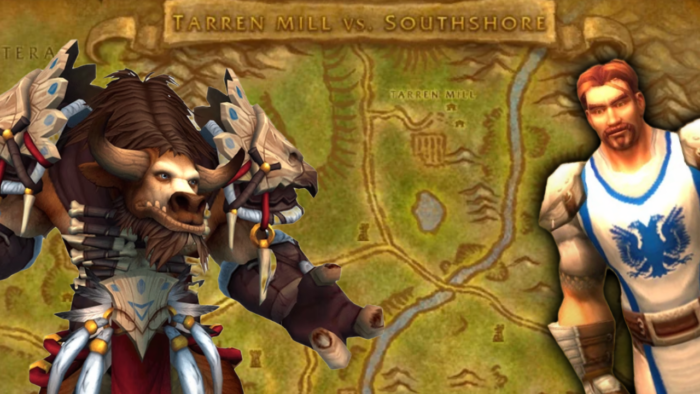
Long before structured battlegrounds, queue systems, and objective markers, World of Warcraft players created their own war. In the Hillsbrad Foothills, the Horde outpost of Tarren Mill and the Alliance town of Southshore became the center of the most famous world PvP conflict in MMO history. It had no rules, no scoreboard, and no scheduled start time. Yet for years, it functioned as the game’s most active battlefield.
The war began because of geography and player movement rather than developer intent. Tarren Mill and Southshore were positioned only a short ride apart along a major travel route, and both served as quest hubs for players in their mid-20s to early-30s. This ensured constant overlap between factions. Hillsbrad also featured nearby graveyards that allowed fallen players to return to battle quickly, flat open terrain ideal for large fights, and towns that could be attacked but were difficult to fully defend. Together, these factors created continuous friction.
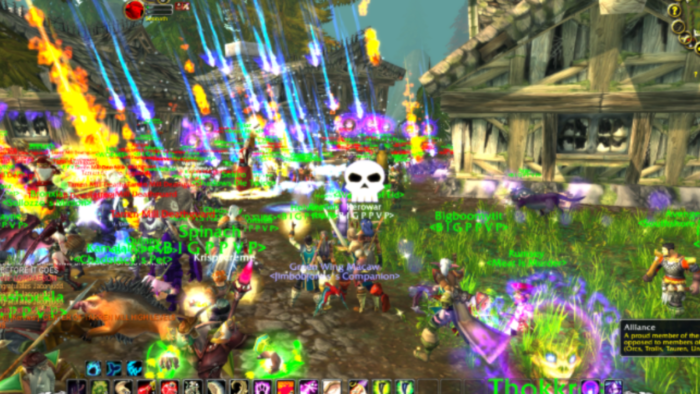
When the Honor System arrived during early Vanilla WoW, players suddenly had a strong incentive to kill members of the opposing faction. There were no battlegrounds yet, so Hillsbrad became one of the most efficient places to farm honor. Raids formed to assault enemy towns, rogues and druids ambushed travelers on the roads, and small skirmishes escalated into zone-wide battles. At peak hours, the entire zone functioned as an open warfront.
The battles themselves had no official trigger and no single instigator. Conflict typically escalated in a predictable way: one player attacked an enemy on the road, nearby players joined, reinforcements rode out from each town, guards were killed, and full raids formed in response. Retaliation cycles ensured the fighting rarely stopped. No individual player or guild is credited with starting the conflict; it emerged naturally from faction rivalry and repeated acts of revenge.
Once fighting began, control shifted back and forth across the zone. Alliance raids pushed toward Tarren Mill, Horde forces counterattacked toward Southshore, and fallen players returned within seconds via nearby graveyards. Reinforcements arrived continuously as more players heard about the battle through chat channels and guild messages. On busy servers, hundreds of players could converge at once, sometimes causing severe lag or even server instability.
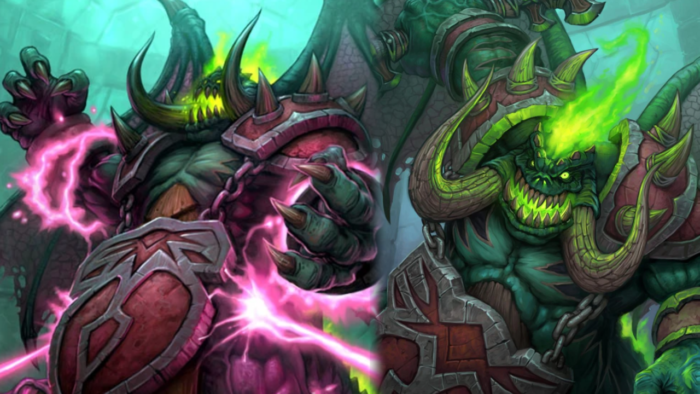
Unlike later battlegrounds, Hillsbrad combat felt unscripted and unpredictable. Players fought because their faction needed help, guildmates were under attack, honor was available, or retaliation felt necessary. There were no timers to run out and no objectives to complete. The battle ended only when players chose to leave.
For those leveling through Hillsbrad at the time, the war was not optional. Players in their mid-20s often found themselves questing inside an active battlefield. Crossing a field could mean running into two clashing raid groups. A high-level player might ride through and eliminate low-level characters in seconds. Many found themselves repeatedly returning from the graveyard just to turn in a quest. Others waited for escorts or delayed quests until the fighting moved elsewhere.
The experience could be frustrating, but it also made the world feel alive. Danger was not scripted; it was created by other players. Routine tasks carried tension, and survival sometimes depended on cooperation with strangers. For many, Hillsbrad was the first time World of Warcraft felt less like a controlled environment and more like a living conflict.
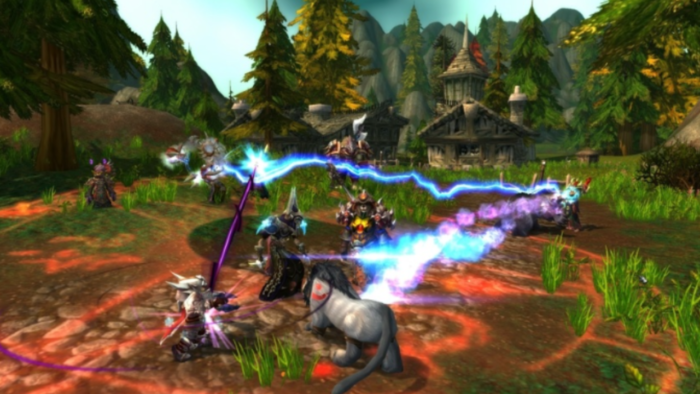
The introduction of battlegrounds in Patch 1.5 marked the beginning of the end. Warsong Gulch and Alterac Valley offered structured objectives and more efficient honor gains, drawing players away from Hillsbrad. Later expansions shifted leveling routes and reduced traffic through the zone. Eventually, Cataclysm’s story changes resulted in the Forsaken destroying Southshore, permanently ending the conflict.
Despite its disappearance, the Hillsbrad war remains one of the most iconic events in World of Warcraft history. It demonstrated how game systems, geography, and faction rivalry could produce large-scale conflict without developer scripting. For many veterans, it represents a defining memory of early MMO culture — spontaneous warfare, faction pride, and a world shaped as much by its players as by its creators.
Tarren Mill vs. Southshore was never an official battleground. Yet for a generation of players, it was the most authentic battlefield Azeroth ever had.