For many people who played World of Warcraft in its early years, the game was never just a hobby. From the outside, it looked repetitive, time-consuming, and socially isolating. Inside, it felt like a place that remembered you. That difference explains why so many players still speak about it with a kind of quiet reverence.
At first contact, WoW did not impress in the way modern games try to impress. You killed boars. You walked long distances. You read quest text. Progress came slowly and without spectacle. Yet this deliberate pace built something more durable than instant excitement. Small rewards — a new ability, a piece of gear, a level gained — created momentum. What began as routine gradually turned into attachment. Logging off did not end the experience; it only paused it.
WoW’s true strength was not mechanics but presence. Cities were full of players conducting their own business: crafting, trading, dueling, idling, arguing in chat. You were not the center of the world; you were one person inside it. The result was a rare feeling in games: you were not playing through content, you were inhabiting a place. Over time, names became familiar. Guild tags carried reputations. A helpful stranger might be remembered for weeks. A hostile encounter in world PvP could turn into a long-running grudge. The server itself functioned as a social memory.
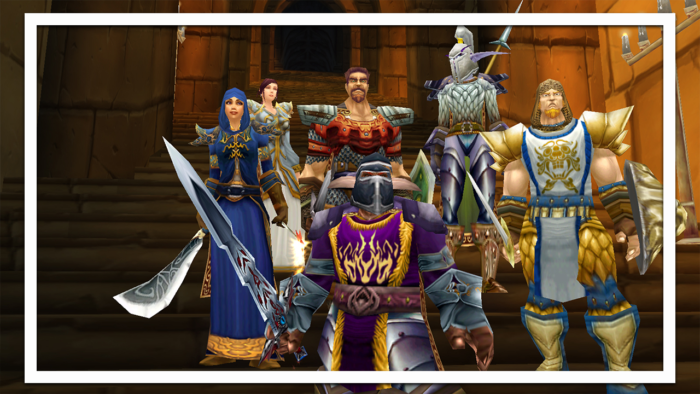
Group content revealed how dependent the experience was on other people. Dungeons and raids required coordination, patience, and trust. Success felt shared; failure felt communal. Reputation mattered. A player who behaved selfishly might find themselves quietly excluded. These consequences were not coded systems but social ones, enforced by memory and communication. In this way, WoW resembled a town more than a game.
The stories that emerged from that environment became part of its identity. Server-wide events, accidental design glitches, legendary mistakes, or unforgettable raid moments were retold like folklore. They mattered not because they were scripted, but because they were shared. Players did not merely consume content; they generated history.
Classic-era WoW, in particular, is remembered less for its features and more for its tempo. Travel took time. Danger existed between destinations. Players encountered each other repeatedly while leveling. Progress felt earned rather than delivered. When fresh servers opened and everyone began again from nothing, the world regained its vitality. Economies were unsettled. Rivalries formed early. Every upgrade mattered. For veterans, this was not nostalgia for old mechanics, but for a social rhythm that made the world feel alive.
The late game revealed another truth: progression did not end with power. Players pursued long-term goals — mounts, reputation, professions, rare drops — that functioned less as advantages and more as personal projects. These pursuits signaled dedication, patience, and identity. Seeing someone’s mount or gear told a story about the time they had invested and the experiences they had endured.
World of Warcraft gained a reputation for consuming time, and in many cases that reputation was deserved. The game’s structure rewarded persistence and routine. Yet the attachment players felt was not rooted in compulsion alone. It came from belonging to a shared environment that evolved through interaction. The game did not simply present challenges; it provided continuity. Logging in meant returning to a world that had continued without you and would continue after you left.
That continuity is what many former players miss. They do not miss killing boars or grinding quests. They miss the feeling of recognition, the shared victories, the slow building of a character within a world that felt inhabited rather than staged.
World of Warcraft did not create nostalgia through spectacle. It created it through repetition, memory, and community. For those who lived inside it, the experience was not defined by any single moment, but by the accumulation of ordinary ones that, together, felt meaningful.