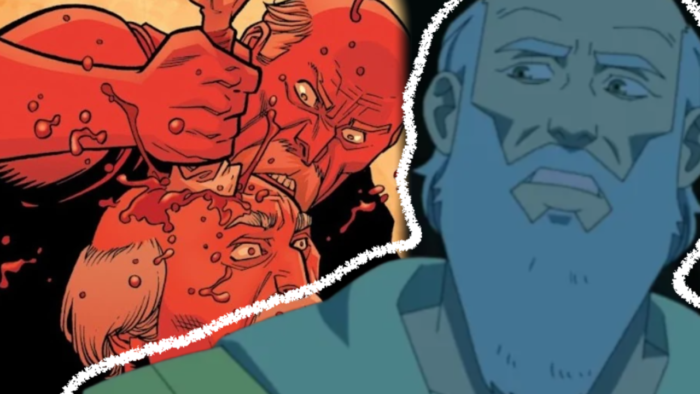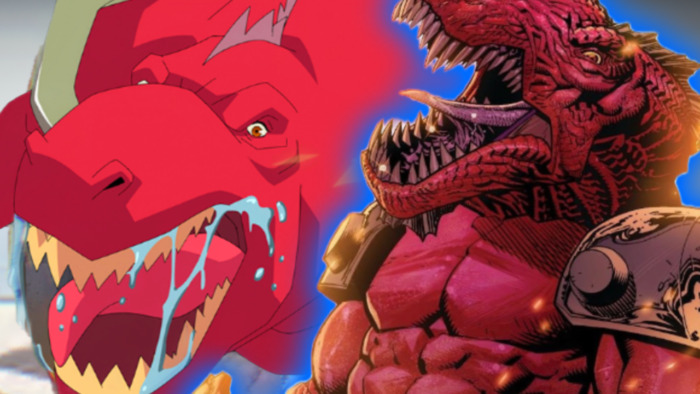
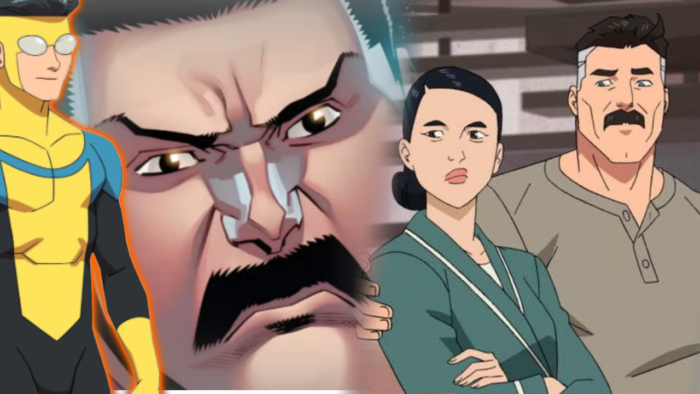
There is a moment in Invincible that feels less like a battle scene and more like an interrogation of power itself. When Thragg chooses not to immediately destroy Nolan Grayson and Mark Grayson, despite having both the authority and the strength to do so, the question stops being “what will happen next?” and becomes “why didn’t he act?” That hesitation, that restraint, is where the real story begins—not of war, but of ideology, psychology, and control.
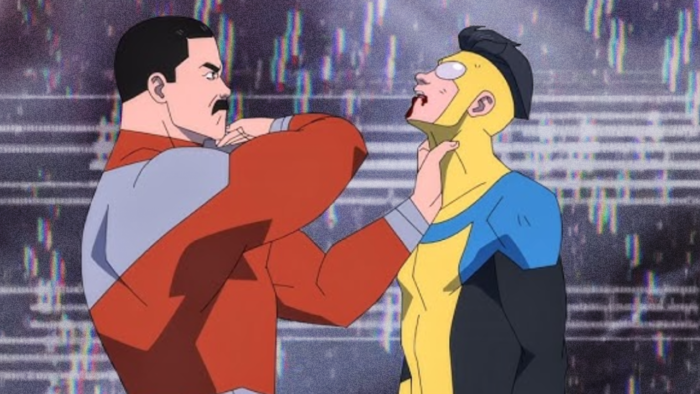
A Leader Who Doesn’t React—He Calculates
Thragg’s composure is not accidental. When challenged, even subtly disrespected, he does not lash out. This is not restraint born from weakness—it is restraint born from certainty. Individuals driven by fragile egos tend to react instantly to threats, especially public ones. Thragg does the opposite. He absorbs the insult, processes it, and responds only when it serves a purpose. That alone separates him from the more impulsive figures within Viltrumite society.
What emerges from this behavior is a pattern: Thragg is not interested in proving his power in the moment. He is interested in maintaining it long-term. His calm delivery, his measured pauses, even his willingness to say “perhaps I am mistaken,” are not signs of doubt. They are tools. By presenting himself as thoughtful rather than reactive, he reinforces authority without needing to display force.
This becomes even more evident in how he treats dissent within his ranks. When others question Viltrumite ideology, he does not immediately eliminate them. Instead, he observes, evaluates, and determines whether their existence serves a broader purpose. Strength, to Thragg, is not just physical—it is ideological alignment. Weakness, in his worldview, is not simply inability, but deviation.
Mercy as Strategy, Not Compassion
At first glance, Thragg’s decision to spare Nolan and Mark appears inconsistent. This is a character who has no hesitation in erasing entire civilizations, yet here he extends what looks like mercy. But the word “mercy” is misleading. This is not compassion—it is calculation.
Thragg understands the fragility of the Viltrumite population. Every loss matters. Every potential asset becomes valuable. Nolan, despite his betrayal, represents something rare: the ability to integrate, reproduce, and expand Viltrumite influence in ways traditional conquest cannot. Mark represents the future—a bridge between Viltrumite strength and something more adaptable.
Killing them would satisfy immediate control. Keeping them alive preserves long-term survival.
This is the core of Thragg’s mindset. He does not act based on emotion alone, even when emotion is clearly present. He acts based on what ensures the continuation of Viltrum. Even his enemies are evaluated not just as threats, but as potential solutions.
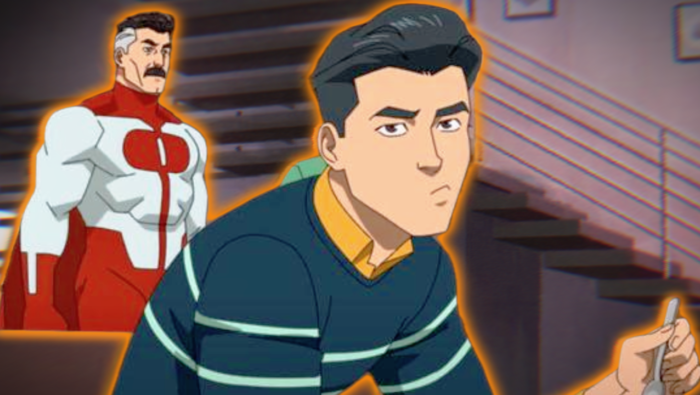
The Weight of Failure
What complicates this further is that Thragg is not emotionless. In fact, his decisions are deeply tied to a personal failure that defines him: the fall of Viltrum. He carries that failure not as guilt in the traditional sense, but as responsibility. The destruction of his people is not something he distances himself from—it is something he internalizes.
Objects like the remains of Emperor Argall are not just relics; they are reminders. Symbols of what was lost, and more importantly, what must be restored. This transforms Thragg from a simple tyrant into something more dangerous—a leader driven by purpose rather than ego.
That purpose shapes everything. It explains why he enforces strength so ruthlessly. It explains why he cannot tolerate ideological weakness. And it explains why he views mercy not as kindness, but as a necessary risk when it serves rebuilding.
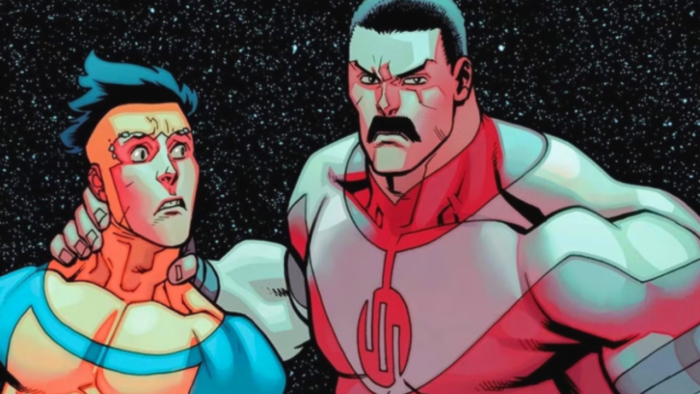
A Fundamental Miscalculation
Despite his intelligence, Thragg has a critical blind spot. He assumes that what matters most to him—Viltrum—must matter equally to others. This is where his understanding of Nolan collapses.
For Thragg, family is collective. It is the empire, the species, the legacy. For Nolan, family is personal. It is his children. His choices are not driven by the restoration of Viltrum, but by the protection of something far smaller—and far more meaningful to him.
This difference is not just philosophical. It is irreconcilable.
Thragg attempts to persuade Nolan using logic rooted in his own values: survival, dominance, restoration. But Nolan operates on a completely different axis. To him, saving his children outweighs rebuilding an empire. That disconnect ensures that no negotiation, no matter how calculated, will ever truly succeed.
The Reality Behind the Mask
What makes Thragg compelling is not just his power, but the contradiction within it. He is capable of immense destruction, yet he feels the loss of every Viltrumite. He enforces brutal order, yet he believes it is necessary for survival. He shows restraint, yet it is always tied to strategy, not morality.
In the end, his decision to spare Nolan and Mark is not about forgiveness. It is about utility. It is about preserving what might be needed to rebuild what was lost.
But there is another possibility, one that lingers beneath the surface. By sparing them, Thragg may also be attempting to share his burden—to make them experience the same loss, the same collapse, the same weight that drives him. Not out of vengeance alone, but out of a belief that only through that suffering can they understand him.
That is what makes his character unsettling. Not the violence, not the power—but the logic behind it.