
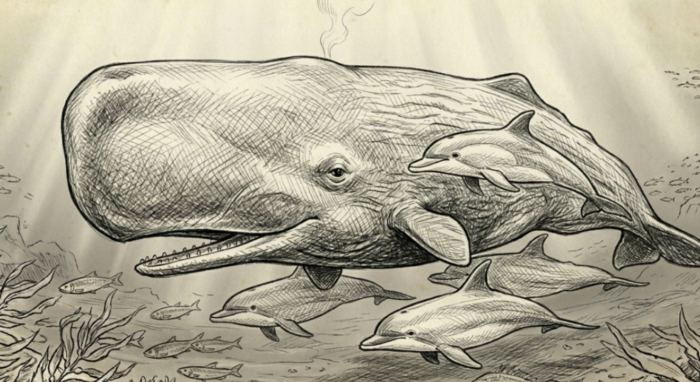
When people see whales and dolphins swimming together in the wild, jumping through waves, circling each other, or moving in sync, the moment feels almost too perfect to question. It looks peaceful, even playful, and most people leave it at that without thinking much further. But when scientists began studying these interactions more closely, it became clear that what looks like simple play is actually something far more complex, and in many ways, far more revealing about how these animals think and behave.
Whales and dolphins are not just randomly crossing paths in the ocean. They belong to the same broader group of animals, known as cetaceans, and they share traits that immediately set them apart from most other marine life. Both are highly intelligent, socially structured, and capable of complex communication, which means that when they encounter each other, they are not reacting purely on instinct. Instead, they are interacting in ways that suggest awareness, curiosity, and in some cases, even cooperation.

One of the most important things researchers have found is that these interactions are not rare or accidental. In a large study examining nearly two hundred encounters between whales and dolphins, a significant portion of those interactions were classified as positive or mutual, meaning both animals were actively engaging with each other rather than avoiding or attacking. That alone challenges the assumption that different species in the ocean only meet in competition or conflict, because it shows that these animals are choosing to interact, and in many cases, choosing to do so in a way that resembles play.
A clear example of this behavior can be seen in what scientists call “bow riding,” where dolphins swim alongside whales and position themselves in the pressure waves created by the whale’s movement. This allows them to glide effortlessly through the water, often staying alongside the whale for extended periods of time. There is no survival advantage that requires this behavior, and it is not part of hunting or defense, which is why researchers widely consider it a form of play. What makes it even more interesting is that whales do not react aggressively or attempt to push the dolphins away. Instead, they tolerate the behavior, and in some cases, appear to move in ways that allow it to continue, suggesting that the interaction is not one-sided.
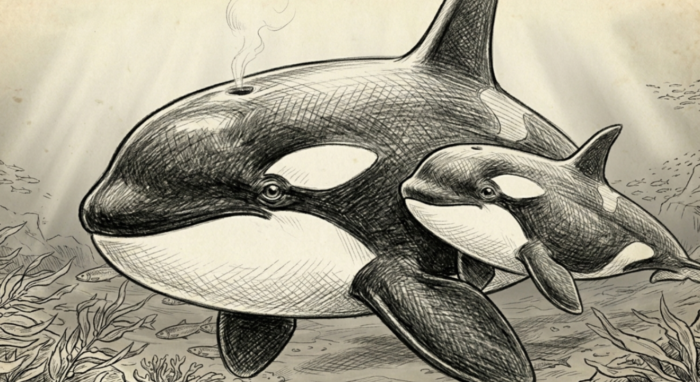
Another explanation that scientists have explored is that this kind of behavior may serve as a form of practice or learning. Just like many intelligent animals, whales and dolphins engage in activities that help them develop coordination, timing, and social awareness. What looks like playful chasing or light physical contact may actually be a way for them to refine skills that are useful in hunting or navigating their environment. In this sense, play is not meaningless, but part of how these animals grow and adapt, allowing them to test boundaries and understand movement in a low-risk setting.
What makes these interactions even more surprising is that they are not always limited to play. In some cases, whales and dolphins have been observed working together in ways that suggest a level of cooperation that goes beyond simple curiosity. There have been documented situations where orcas and dolphins hunted in the same area, with dolphins acting as scouts to locate fish using echolocation while orcas followed to capture the prey. Afterward, dolphins would feed on the leftovers, creating a dynamic where both species benefited from the interaction. What stands out in these situations is not just the cooperation, but the complete absence of aggression, even though orcas are fully capable of preying on dolphins in other contexts.

This raises an important point, because the relationship between whales and dolphins is not always peaceful. Some types of orcas, particularly those that hunt marine mammals, do prey on dolphins, which means that the interactions between these species depend heavily on the type of orca, the environment, and the situation. That is part of what makes the more friendly or playful encounters so interesting, because they show that behavior is not fixed or purely instinctive. Instead, it can shift based on familiarity, opportunity, and learned patterns.
Curiosity also plays a major role in these interactions, especially when different species encounter each other in open water. Whales and dolphins have been observed approaching one another slowly, circling, mirroring movements, and even making light physical contact without any signs of aggression. These behaviors suggest that they are investigating each other, much like how humans might approach something unfamiliar. Over time, repeated encounters like this can build a level of familiarity, which may explain why some interactions appear more relaxed and coordinated than others.
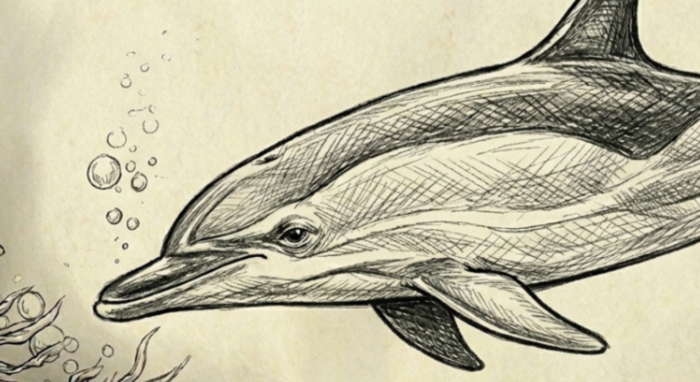
When all of this is considered together, the idea that whales and dolphins simply “play” with each other becomes an oversimplification. What is actually happening is a combination of social behavior, learning, curiosity, and in some cases, cooperation. These animals are not just reacting to their environment, but actively engaging with it in ways that show awareness and flexibility, which is something we do not often associate with life in the ocean.
In the end, these interactions reveal something important about whales and dolphins as a whole. They are not isolated creatures acting purely on instinct, but highly intelligent animals capable of forming complex behaviors that go beyond survival. The fact that different species can come together, sometimes without conflict and sometimes even with shared purpose, challenges the way we think about animal behavior and suggests that the ocean is far more socially connected than it appears on the surface.
What looks like a simple moment of play is, in reality, a glimpse into a much deeper system of interaction, one that shows just how advanced these animals truly are.