
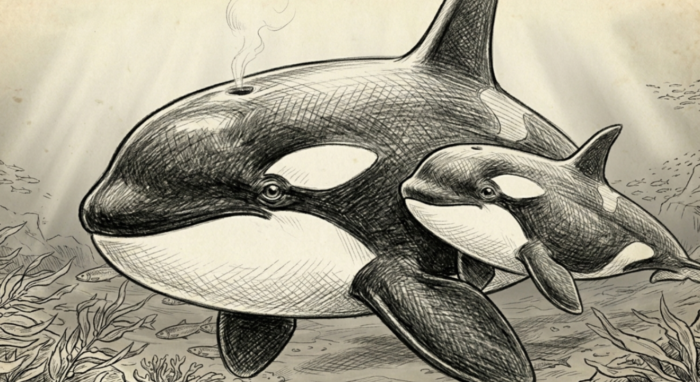
When people hear the name killer whale, the reaction is almost automatic. The image that comes to mind is something powerful, aggressive, and unpredictable, an animal sitting at the very top of the ocean that could turn on a human at any moment if it wanted to. It feels logical, especially when you consider what orcas are capable of, because these are animals that hunt in coordinated groups, take down prey larger than themselves, and have even been documented killing great white sharks with calculated precision.
But once you move past the name and start looking at how orcas actually behave in the real world, that perception begins to break down in a way that is difficult to ignore, because the evidence does not support the idea that they are a danger to humans in the way people assume.
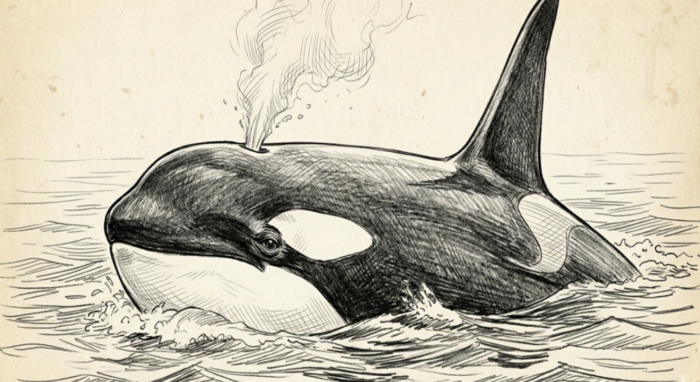
The most important place to start is with the simplest and most consistent fact: there has never been a confirmed fatal attack on a human by a wild orca. That is not a recent statistic or something limited to a specific region, but a pattern that has held across recorded history, despite the fact that humans and orcas have shared the same waters for centuries. When you consider how often people enter the ocean through swimming, diving, surfing, and boating, the absence of fatal encounters becomes more than just surprising, it becomes something that demands explanation.
Even when you look for examples of non-fatal interactions, there is very little to find. The most commonly referenced incident dates back to 1972, when a surfer off the coast of California was bitten by an orca. At first glance, this seems like the kind of moment that would confirm the danger people expect, but the details tell a different story. The surfer was lying on a board wearing a black wetsuit, which from below closely resembles a seal, one of the orca’s natural prey. Researchers widely believe this was a case of mistaken identity, and what stands out even more is that the orca released him almost immediately, rather than continuing the attack in the way a true predator typically would.
That pattern of restraint continues across other encounters, and in many cases, it shifts even further away from aggression. There are numerous documented situations where wild orcas approach humans without any sign of hostility, swimming alongside boats, circling divers, or simply observing from a close distance. These are not isolated incidents, but repeated behaviors that suggest curiosity rather than threat, which is not what most people expect from an apex predator.
Some of the most striking examples go even further, showing behavior that is difficult to explain if you assume orcas see humans as prey. In several recorded cases, orcas have been observed offering food to humans, approaching with fish or other prey and dropping it nearby while watching for a reaction. Between 2004 and 2024, researchers documented dozens of these interactions, and while the exact motivation is still debated, the behavior itself suggests a level of curiosity and engagement that does not align with the idea of a dangerous predator looking for an opportunity to attack.
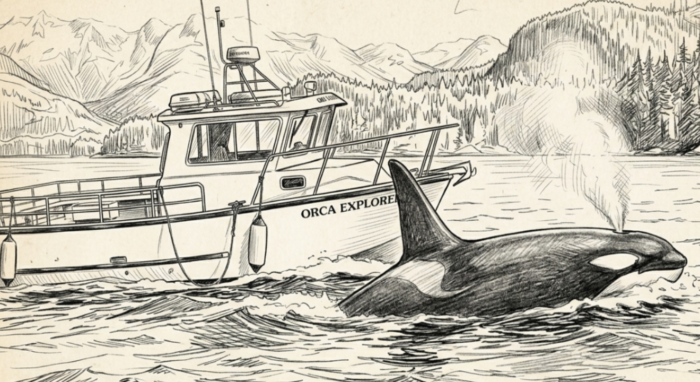
Even the more recent headlines about orcas interacting with boats do not tell the story people think they do. Off the coast of Spain and Portugal, there have been hundreds of incidents where orcas have bumped or damaged vessels, often targeting the rudder. While this behavior has been labeled as “attacks” in media coverage, researchers studying these events suggest that it is more likely exploratory or playful behavior, particularly among younger orcas, and despite the number of encounters, there have been no reports of humans being harmed during these interactions.
At this point, the pattern becomes difficult to dismiss, because it is not based on a single event or a handful of unusual cases, but on a consistent body of evidence showing that orcas do not treat humans as prey. This raises a more important question, which is not just whether orcas are dangerous, but why they consistently choose not to be.
Part of the answer lies in how orcas hunt, because unlike many predators, they are highly specialized and culturally driven in their behavior. Different groups of orcas, known as pods, develop specific hunting techniques and diets that are passed down over generations, meaning they do not randomly target whatever is available, but instead focus on the types of prey they have learned to hunt. Humans do not fit into that system, not in appearance, not in movement, and not in behavior, which means we are not recognized as a food source in the same way as seals, fish, or other marine animals.
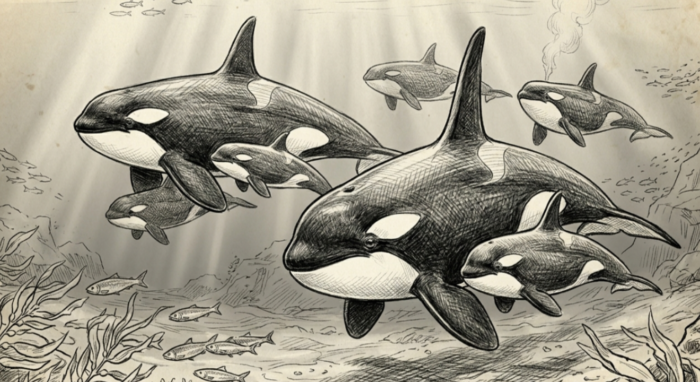
Another important factor is intelligence, because orcas are not just strong hunters, but highly aware and socially complex animals. They are capable of learning, adapting, and making decisions based on experience, which means their interactions are not purely instinct-driven. When they encounter humans, their behavior suggests evaluation rather than reaction, and in many cases, that evaluation leads to curiosity instead of aggression.
This is where the conversation often gets confused, because many of the fears surrounding orcas come from incidents that did not happen in the wild, but in captivity. There have been several serious and even fatal encounters between orcas and trainers in marine parks, and those events have played a major role in shaping public perception. However, the conditions in captivity are fundamentally different from the natural environment, with orcas being confined to small spaces, separated from their social groups, and subjected to routines that do not reflect their natural behavior. Under those circumstances, stress and behavioral changes are not surprising, and it becomes difficult to use those incidents as a reflection of how orcas behave in the wild.
When you separate those two environments and focus only on natural behavior, the conclusion becomes much clearer. Orcas are not harmless animals, and it would be unrealistic to suggest that any apex predator should be approached without caution, but the idea that they are a significant threat to humans is not supported by evidence. Instead, what the data shows is an animal that is capable of extreme power, yet consistently chooses not to use that power against us.
That contrast is what makes orcas so fascinating, because they challenge the way we think about danger in the natural world. They have every physical advantage needed to be one of the most feared animals in the ocean, yet their behavior toward humans is defined by restraint, curiosity, and in some cases, even interaction that feels unexpectedly calm.
In the end, the story of orcas is not one of hidden danger waiting to surface, but of a reputation that has grown far beyond what reality supports. The more you look at the evidence, the harder it becomes to see them as the threat they are often made out to be, and the easier it becomes to understand them for what they actually are—one of the most intelligent and controlled predators in the ocean, not because they lack the ability to harm us, but because they consistently choose not to.