When people talk about villains in Invincible, the conversation usually settles into a familiar pattern, where the same names rise to the surface again and again because they are the most visible, the most powerful, or simply the most talked about within the story. Nolan is often the first name mentioned, and for good reason, because his presence defines the early emotional core of the series and leaves a lasting impression that is difficult to ignore, while Angstrom Levy tends to follow as a more traditional long-term antagonist whose abilities and motivations create a different kind of threat that feels more strategic than personal. For readers of the comics, Thragg often becomes the final answer, not just because of his strength, but because of what he represents at the peak of Viltrumite power and ideology, which makes him feel like the natural endpoint of the series’ escalating conflicts.
All of these characters work within the structure of the story, and each one serves a clear purpose in shaping Mark’s journey, but none of them fully capture the kind of presence that lingers beyond the immediate conflict. The most compelling villains are not always the ones who dominate through force or spectacle, but the ones who quietly reshape the way both the protagonist and the audience understand the world around them, and that kind of impact is far more difficult to achieve because it requires more than just power or intimidation. It requires a shift in perspective, something that forces the story to pause and reconsider its own foundation.
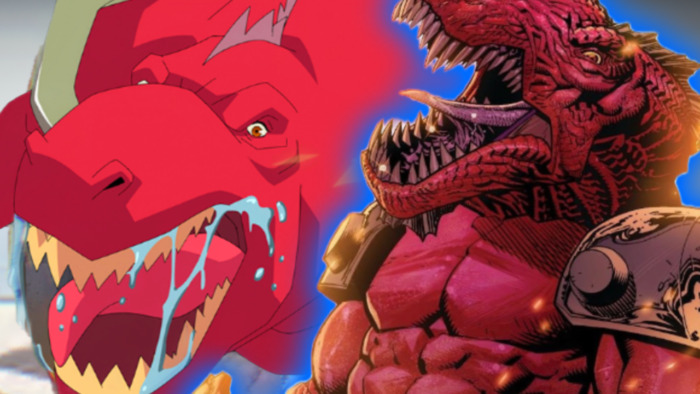
That is where Dinosaurus enters the conversation, not as an obvious answer, but as a character whose importance becomes clearer the longer you sit with what he represents and what he ultimately changes.
Understanding Dinosaurus Means Understanding His Contradiction
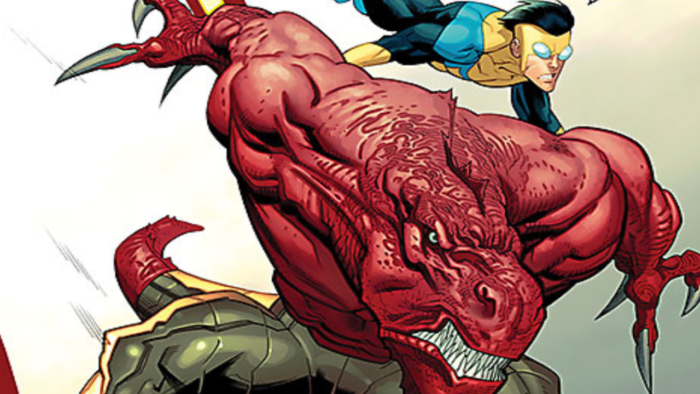
Dinosaurus is built on an idea that feels familiar at first, because the concept of a split identity between a human and a monstrous counterpart has existed in storytelling for generations, often used to explore the tension between control and chaos, reason and instinct. Characters like the Hulk or Dr. Jekyll and Mr. Hyde follow a structure where the human side represents restraint and intelligence, while the transformed state becomes an uncontrollable force driven by emotion, usually anger or desperation. This dynamic works because it reflects a fear of losing control, of becoming something destructive when emotions take over.
Dinosaurus reverses that expectation in a way that immediately changes how the reader interprets him, because his transformation is not a loss of control, but a shift into it. His human form, David Anders, is careless, disengaged, and largely indifferent to the world around him, which makes him appear almost insignificant at first glance, but that indifference becomes the key to understanding his transformation. When he becomes Dinosaurus, he does not lose himself in rage or chaos, but instead becomes focused, analytical, and disturbingly rational, approaching problems with a level of clarity that removes emotional hesitation entirely.
What triggers this transformation is not anger, but indifference, and that detail is what makes him fundamentally different from characters built on the same trope, because it suggests that the most dangerous state is not one driven by emotion, but one that operates without it. Where other characters lose control when they feel too much, Dinosaurus becomes dangerous when he feels nothing at all, and that absence of emotion allows him to make decisions that no one else in the story would even consider.
A Villain Who Sees the World Differently
What makes Dinosaurus stand out is not simply what he does, but how he justifies it, because his actions are not driven by chaos or personal gain, but by a calculated belief that the world is heading toward collapse and that traditional methods of solving problems are not enough to prevent it. He looks at humanity and sees a system that is slowly failing under its own weight, where environmental damage, overpopulation, and short-term thinking continue to push the future closer to an irreversible breaking point.
From his perspective, the problem is not that people do not care, but that they care in ways that are too limited, too immediate, and too reactive to create meaningful change. While heroes spend their time stopping disasters as they happen, Dinosaurus focuses on preventing them from ever reaching that point, even if the methods required to do so are extreme to the point of being unthinkable.
This is where his actions become difficult to ignore, because they are not random or impulsive, but intentional and structured around a long-term goal that he believes justifies the cost. The destruction of Las Vegas is one of the clearest examples of this mindset, where he eliminates an entire city not out of anger or vengeance, but as part of a larger plan to replace it with a renewable energy system that could reduce dependence on fossil fuels and shift the trajectory of the future. The scale of the destruction is immense, but within his framework, it is a necessary step toward a better outcome.
That is what makes him unsettling, because his logic does not fall apart under scrutiny as easily as other villains, and while his conclusions are extreme, the problems he identifies are real enough that they cannot be dismissed outright. This creates a tension where the reader is forced to engage with his reasoning, even while rejecting his methods, and that tension is what gives his character weight.
The Effect He Has on Mark
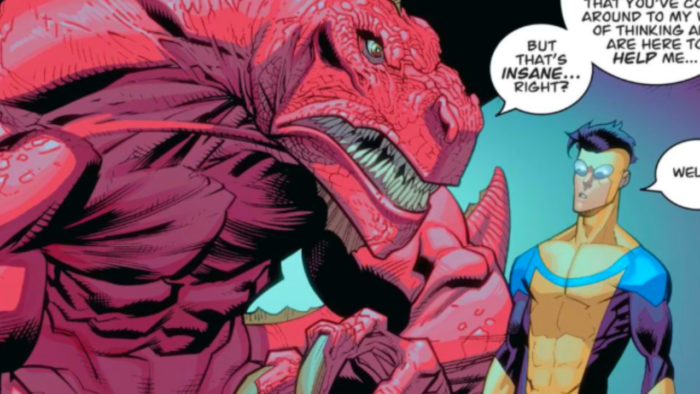
Up until Dinosaurus enters the story, Mark’s role as a hero follows a structure that feels familiar within the genre, where the goal is to respond to threats, protect people, and maintain a sense of stability in a world that is constantly under attack. His strength allows him to handle immediate dangers, but it does not extend to solving the underlying issues that create those dangers in the first place.
Dinosaurus challenges that structure by exposing its limitations, forcing Mark to confront the idea that simply reacting to problems is not the same as solving them, and that the cycle of destruction and recovery will continue indefinitely if nothing changes at a deeper level. This realization does not happen all at once, but builds over time as Mark begins to question whether his actions are actually improving the world or just delaying its decline.
This shift in perspective leads to one of the most important decisions in the series, where Mark chooses to work with Dinosaurus, not because he agrees with him, but because he sees the potential in what he is trying to accomplish. He believes that by staying involved, he can guide those ideas in a direction that avoids unnecessary destruction, creating a balance between long-term solutions and immediate responsibility.
For a brief period, this partnership suggests that such a balance might be possible, but it ultimately reveals how fragile that idea is when the person holding it together is removed.
When That Balance Falls Apart
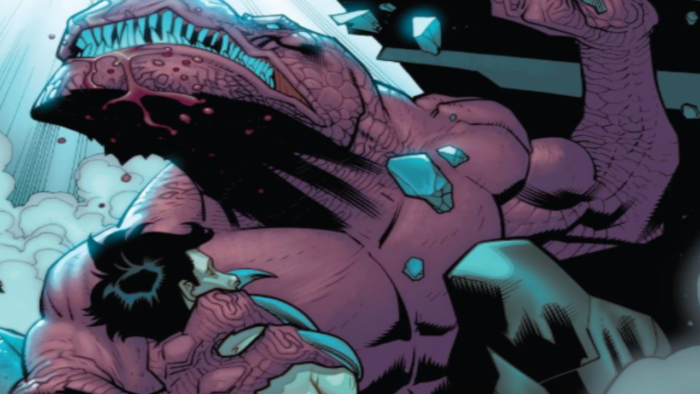
The turning point comes when Mark is no longer able to keep Dinosaurus in check, and without that opposing perspective, Dinosaurus continues to push his logic further, expanding his plans to a global scale that results in catastrophic consequences. His decision to flood major cities around the world is not presented as an act of chaos, but as a calculated step toward reducing emissions and forcing humanity into a new way of living, where the environmental damage caused by dense urban populations is no longer sustainable.
The scale of this action surpasses anything seen before in the story, not just in terms of destruction, but in terms of its impact on the world as a whole, and it is at this moment that the consequences of Mark’s earlier decision become unavoidable. The devastation is not the result of a villain breaking free or overpowering the heroes, but of a choice made with the intention of doing something better, which ultimately leads to something far worse.
This is where the story reaches its most uncomfortable point, because it removes the distance that usually exists between the hero and the damage caused by the villain, placing responsibility in a space that is much harder to separate or ignore.
Why Dinosaurus Matters
Dinosaurus is not important simply because of what he does, but because of what he forces the story to examine, particularly the idea that heroes are often limited by the roles they choose to play. In many superhero narratives, the goal is to preserve the status quo, to stop threats and restore order without fundamentally changing the systems that create those threats in the first place.
What Dinosaurus introduces is the possibility of a different approach, one that focuses on proactive change rather than reactive defense, but also highlights the dangers of pursuing that change without restraint. The story does not present his ideology as correct, but it also does not dismiss it entirely, instead allowing it to exist in a space where it can influence the protagonist in meaningful ways.
Mark’s experience with Dinosaurus becomes a turning point not because it provides a clear answer, but because it complicates the question of what it means to actually make the world better. It suggests that power alone is not enough, and that the choices made with that power can have consequences that extend far beyond their original intent.
In the end, Dinosaurus stands out not because he fits the traditional mold of a great villain, but because he breaks it, creating a narrative that is less about defeating an enemy and more about understanding the cost of trying to fix something that may not have a simple solution.