Most players assume World of Warcraft is the same everywhere. You log in, you raid, you wipe to mechanics, you blame the healer, and life moves on. But the reality is far more interesting. For years, the Chinese version of WoW operated almost like an alternate timeline—similar at its core, yet shaped by entirely different rules, systems, and priorities.
This isn’t just a small localization tweak. Entire visual themes were redesigned. Quest text was rewritten. Payment models were restructured. Even raid progression and exclusive rewards evolved differently. And once you start digging into it, the differences reveal how flexible—and surprisingly adaptable—WoW has been behind the scenes.
Let’s start with the most famous change: the bones.
When Death Needed to Look Less Like Death
China enforces strict regulations on depictions of skeletons, exposed bones, blood, and graphic death imagery in media. For a game built on undead armies, plague zones, and apocalyptic invasions, that presented a problem.
Blizzard had to adjust.
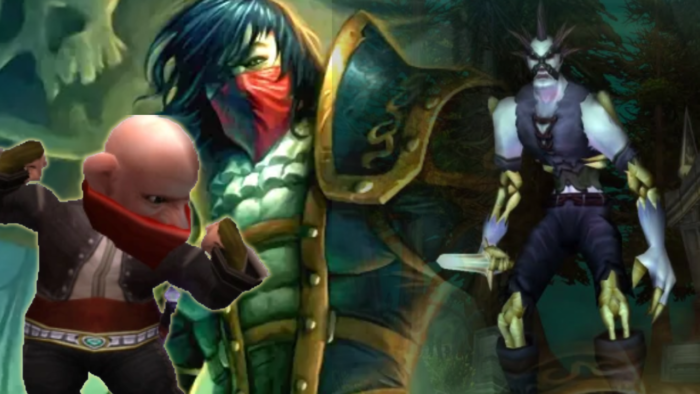
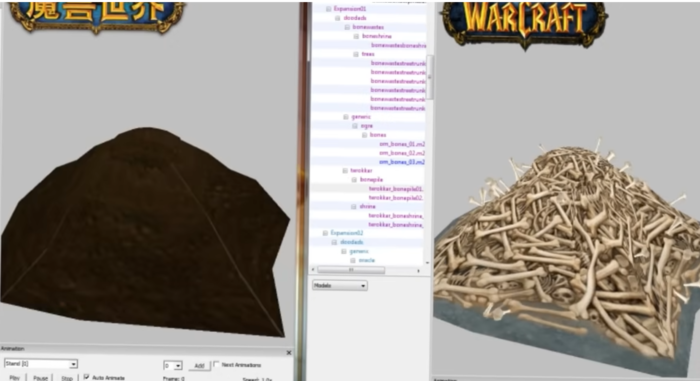
Undead character models that showed exposed ribs or bones were redesigned so that flesh covered skeletal areas. Skulls that decorated armor sets and environments were removed. Red blood and exposed meat textures were recolored green. Entire environmental textures were replaced.
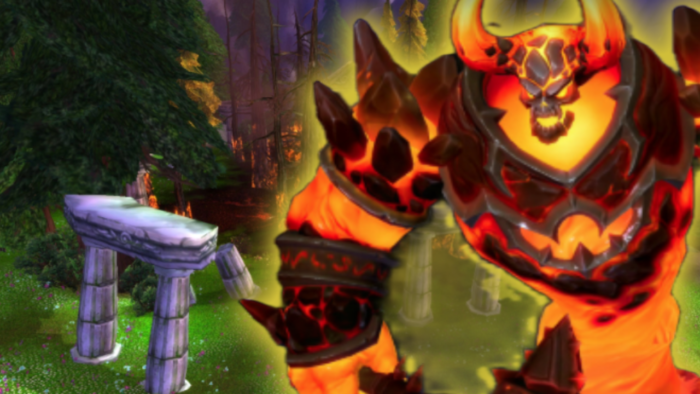
One of the most dramatic examples came during World of Warcraft: Wrath of the Lich King. In the global version, Icecrown Citadel features floors textured with skulls and bones. In China, those were replaced with plain stone textures. Sindragosa—the iconic skeletal frost dragon featured heavily in promotional material—was changed into a fully fleshed blue dragon model. On the login screen for Wrath, she doesn’t appear at all.
Even early versions of Karazhan that contained rooms filled with hanging corpses and skeletal piles were edited, despite never making it into the live global release. The adjustments went deep.
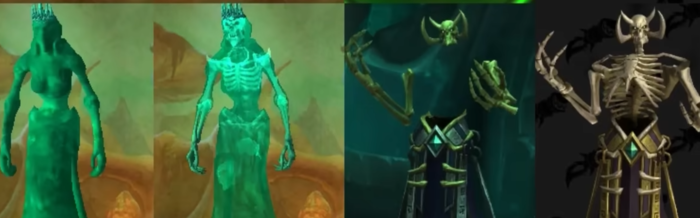
Later, in World of Warcraft: Shadowlands, which revolves entirely around the afterlife, bone-heavy character models were softened and redesigned to reduce skeletal exposure.
And then there’s the player death system. Globally, when a player dies, their skeleton remains behind for a time. In China, those skeletons were replaced with small grave markers. During large PvP battles, instead of a battlefield covered in bones, you see rows of tombstones. It changes the atmosphere in subtle but noticeable ways.
Even the Words Had to Change
The visual changes are obvious, but the writing adjustments are more revealing.
The Death Knight starting zone, one of the darkest questlines in the game, originally includes explicit instructions to kill prisoners to satisfy a supernatural hunger. In the Chinese version, wording was softened. The emphasis shifted from “kill” to “defeat.” The brutality was dialed back in phrasing, even if the gameplay outcome remained mechanically similar.
In Cataclysm-era Hillsbrad, the global version describes ghouls attacking buried farmers and eating their heads. Players are given the option to rescue or kill them. In China, those graphic descriptions were removed or shortened. The quests still exist, but the tone shifts away from explicit gore.
Not every quest was rewritten, but enough were adjusted to show a clear pattern. The darker edges were smoothed without fundamentally changing gameplay structure.
The Hourly Payment Experiment
While most of the world paid for WoW with a monthly subscription, China initially operated under a time-based system. Instead of paying for a month, players purchased blocks of minutes.
Early options included 4,000 minutes of game time for a fixed price. That time counted only while actively playing, meaning players could stretch those minutes across weeks or months. Later, the system shifted to 2,700-minute and 1,350-minute options.
This model likely evolved from the popularity of internet cafés, where players rented computers by the hour. A traditional subscription didn’t make sense if you only played a few hours a week outside your home.
Eventually, as home PC ownership increased, the system transitioned to a more standard subscription model. But for years, China effectively ran WoW on a pay-by-the-hour structure that no other major region used.
Exclusive Mounts, Events, and Monetization Shifts
Here’s where things get especially interesting.
China received exclusive promotions and event systems that never appeared globally. Rare mounts that cost thousands of dollars on trading card markets elsewhere became part of subscription bundles or event rewards.
The Reins of the Swift Spectral Tiger, one of the rarest mounts in the global version, was made available through promotional bundles and later anniversary events in China. Large-scale Lunar New Year events introduced lootbox-style systems where players could earn rare mounts, toys, and cosmetics.
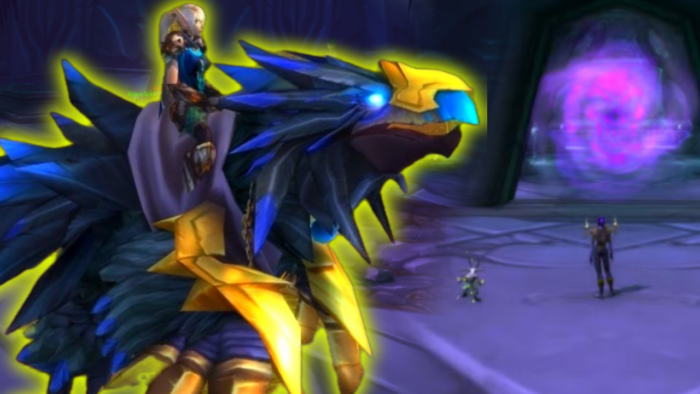
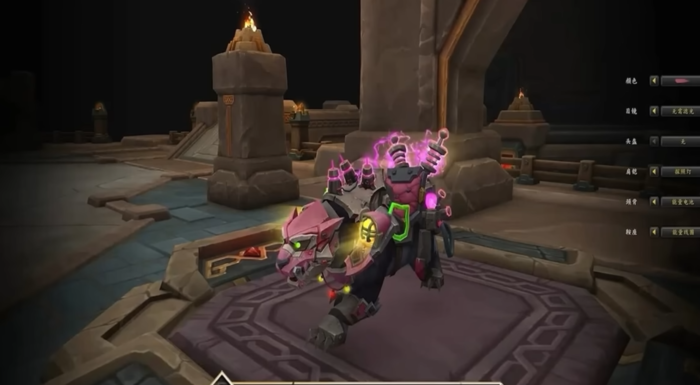
Some events even included customizable mounts and flying dragons equipped with vendor services and mailbox functionality. These rewards were distributed through systems that resembled gacha mechanics—something Western audiences historically respond to with heavy backlash.
The divergence here is cultural and economic. What works in one region doesn’t always translate cleanly to another.
Raid Scaling and Competitive Differences
During World of Warcraft: Mists of Pandaria, item drops in Asian regions came with two upgrades already applied. That meant players started with higher item levels from raid drops compared to global regions.
To compensate, bosses dealt more damage and had more health. The tuning was mathematically offset, but the starting progression curve differed.
Later, during raid races such as Siege of Orgrimmar, these differences became a topic of discussion. Regional variations in tuning added another layer to the competitive scene.
There was even a controversy surrounding the Hall of Fame system, which tracks the first 100 guilds to defeat Mythic raid bosses. The Chinese publisher reportedly investigated suspicious clears by directly contacting players and asking detailed questions about boss mechanics. Guilds that could not explain strategies were removed from rankings and penalized.
It was an unusually hands-on approach to competitive integrity.
A Different but Familiar Warcraft
At its core, the Chinese version of WoW was still WoW. The same expansions. The same raids. The same lore crafted by Blizzard Entertainment. But the presentation, systems, and incentives were shaped by regional laws, market realities, and player expectations.
The result wasn’t a lesser version. It was a parallel one. A version where bones turned to stone, skeletons became gravestones, rare mounts flowed through holiday events, and raid rankings sometimes required you to answer questions like you were defending a thesis.
It’s easy to think of WoW as one monolithic global experience. But in reality, it has always been more adaptable than that. And nowhere is that clearer than in the fascinating case of China’s very different Azeroth.