
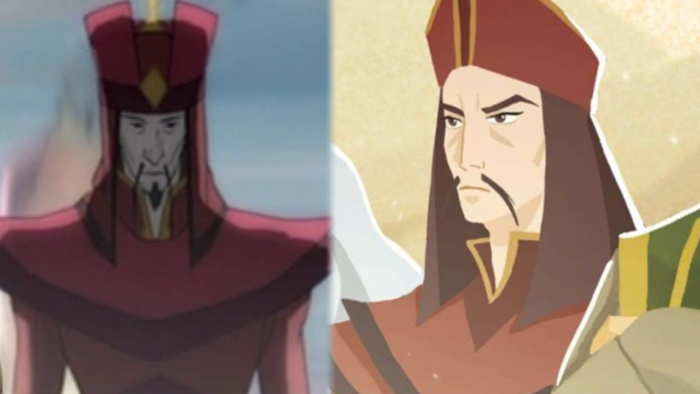
Avatar Szeto lived at a time when the Fire Nation was not a rising empire but a country close to breaking apart. Background lore from the Kyoshi era describes internal instability, with noble families competing for power, regional leaders acting independently, and economic hardship made worse by disasters and resource strain. Instead of acting as a wandering peacekeeper, Szeto chose to work within the Fire Nation government. As referenced in the Kyoshi novels, he entered the bureaucracy and rose to a high administrative role serving the Fire Lord, using policy and governance to stabilize the nation.
One of his first priorities was restoring central authority. Powerful clans had been operating almost like rival governments, and their conflicts threatened to fracture the state. Szeto mediated disputes and helped bring regional power back under the Fire Lord’s control. This reduced internal conflict and created a unified chain of command. The Fire Nation already possessed a centralized monarchy, but during Szeto’s era that structure was under strain; his work reinforced and preserved it.
The Fire Nation’s economy was also in crisis. Currency instability and loss of fiscal trust had disrupted trade and weakened governance. Szeto worked to stabilize financial systems and restore economic confidence. As stability returned, commerce recovered and state revenues strengthened, allowing the government to function effectively again and rebuild essential infrastructure.

Food shortages and agricultural disruption posed another threat. Szeto helped organize relief efforts and systems for managing food supply, preventing famine and unrest in rural regions. These measures stabilized communities and allowed recovery rather than migration or rebellion.
Beyond crisis response, Szeto helped shape a more professional governing system. His legacy is often symbolized by administrative tools such as an abacus and official seal rather than weapons, reflecting his focus on competence, organization, and state service. By emphasizing effective governance over aristocratic rivalry, he strengthened the administrative machinery of the Fire Nation, making the state more capable of managing large-scale policy and coordination.

Fire Nation cultural tradition preserves his legacy. The Festival of Szeto, celebrated with lantern displays and harvest symbolism, commemorates stability and prosperity, and Agni Kai duels are traditionally suspended during the observance, reinforcing his association with unity and civil order.
Szeto did not create an imperial state, nor is there canon evidence that he promoted expansion. What he created was stability. Over time, stability led to prosperity. Population growth, improved infrastructure, and expanded trade strengthened the nation across generations. By the time of Avatar Yangchen, the Fire Nation appears stable and functional, suggesting the durability of the systems established during Szeto’s era.
Centuries later, under Fire Lord Sozin, the Fire Nation possessed the centralized authority, economic capacity, and administrative organization needed to mobilize fleets, supply armies, and coordinate a global war effort. Sozin’s imperial ambitions were the result of ideology and political choice, but the strength of the state he commanded depended on the institutional capacity built over generations. A fragmented, famine-stricken nation could not have launched a world war; a stable and prosperous one could.
Szeto saved the Fire Nation from collapse and helped create a system strong enough to endure for centuries. That strength later enabled expansion under different leadership and different values, illustrating how restoring balance in one era can shape the possibilities of the next.