In a game filled with dragons, gods, and world-ending threats, one of World of Warcraft’s most remembered quests is about something far smaller and far sadder: a single orc looking for his wife. Mankrik’s Wife, formally known as the quest “Lost in Battle,” takes place early in the Horde leveling experience in World of Warcraft, yet it has gone on to become one of the most iconic moments in MMO history. Not because it was mechanically complex, but because it captured what early WoW was really about—exploration, confusion, community, and shared experience.
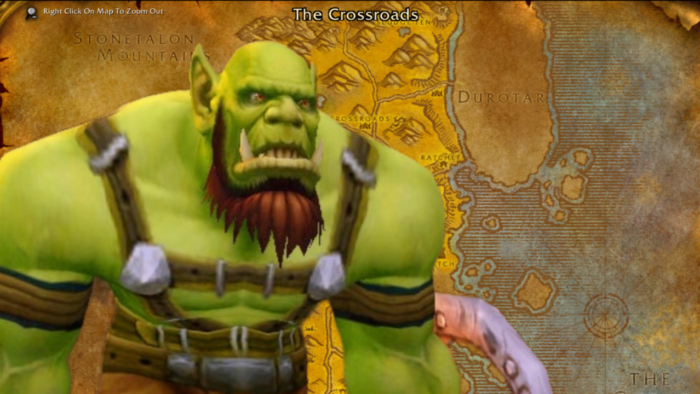
The quest is given by Mankrik, an orc found in The Barrens, a massive, dusty zone that most Horde players passed through in the game’s early levels. Mankrik explains that during a battle with the quillboars, he and his wife were separated. He asks the player to search for her and report back with news. That’s it. No glowing markers. No highlighted area on the map. No helpful arrow pointing the way.
At the time of WoW’s original release, quests did not guide players the way modern games do. Directions were written in text and often vague. In Lost in Battle, Mankrik mentions landmarks like the Gold Road and nearby skirmishes, but nothing that clearly tells the player where to go. The Barrens itself is enormous, filled with enemies, winding paths, and wide stretches of empty land. As a result, players wandered for long periods of time, searching for someone they assumed was still alive.
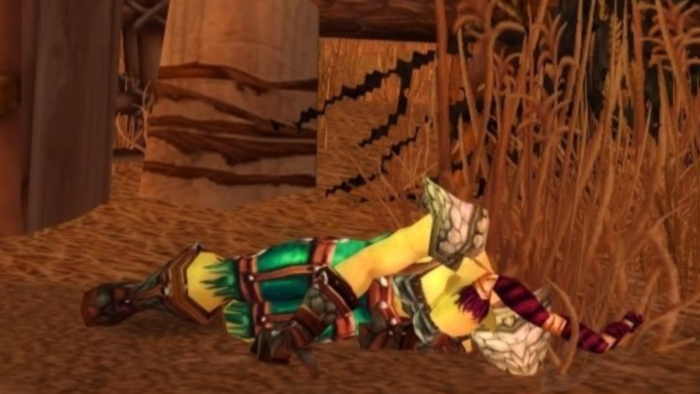
Eventually, those who searched carefully—or got lucky—discovered the truth. Mankrik’s wife is not waiting to be rescued. Her body lies face-down in the dirt near a quillboar camp, represented by a small, easily missed corpse object. Interacting with it confirms her death, and the player must return to Mankrik to deliver the news. There is no dramatic cutscene and no heroic resolution. The quest ends quietly, with grief rather than triumph.
What transformed this simple, somber quest into a legend wasn’t just its content, but how players reacted to it. Because so many people couldn’t find her, Barrens chat—the zone’s general chat channel—became flooded with one repeated question: “Where is Mankrik’s wife?” The line was asked sincerely at first, then sarcastically, then constantly. It became a running joke, spammed endlessly, sometimes answered with real directions, sometimes with deliberate misinformation. Over time, it evolved into one of gaming’s earliest viral memes.
This moment mattered because it wasn’t developer-manufactured humor. It came directly from player frustration and shared experience. Everyone who leveled a Horde character in early WoW either asked the question, answered it, or watched it scroll by endlessly. The quest forced players to talk to one another, whether to help, troll, or commiserate. In an era before YouTube guides and widespread add-ons, that kind of social reliance was central to the MMO experience.
Mankrik’s Wife also represents a design philosophy that many players associate with “classic” WoW. The world didn’t revolve around the player. Quests could fail, end badly, or provide no clear answers. You were expected to read, explore, and sometimes accept that the outcome wasn’t heroic. That realism—especially in contrast to the epic fantasy surrounding it—made the quest feel grounded and memorable.
Years later, when World of Warcraft Classic launched, the meme returned almost instantly. New players encountered the quest for the first time, while veterans relived it with full knowledge of what was coming. Barrens chat once again filled with the same question, proving how deeply the moment had embedded itself into WoW’s culture.
Ultimately, Mankrik’s Wife is remembered not because of loot, rewards, or lore significance, but because it captures the soul of early World of Warcraft. It’s a reminder of a time when the game trusted players to get lost, to ask for help, and to share stories with strangers. In a world of legendary heroes and cosmic villains, it was a single unanswered question in a dusty zone that left the biggest mark.