In the early 1990s, Mighty Morphin Power Rangers reshaped children’s television. Adapted from a Japanese tokusatsu series, it combined Eastern action footage with Western storytelling, creating something entirely new for American audiences. The result was a cultural phenomenon, but also a question that would never fully be answered.
What would Power Rangers have looked like if it had been created entirely in the West?
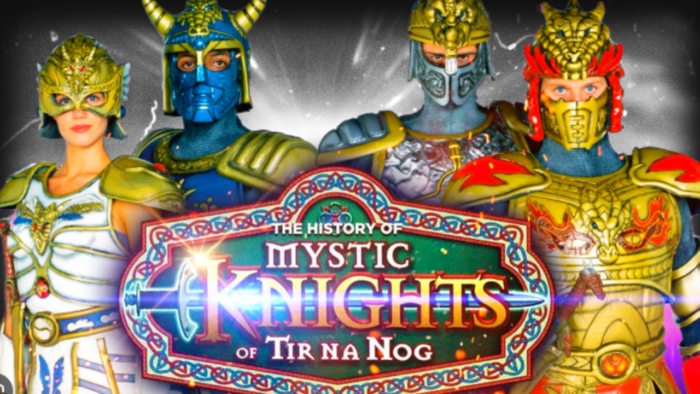
For a brief moment in the late 1990s, Mystic Knights of Tir Na Nog offered a possible answer.
A Show Born Between Two Worlds
Mystic Knights of Tir Na Nog aired from 1998 to 1999 on Fox Kids, arriving at the height of a live-action superhero boom. The television landscape was crowded with costumed heroes, transformation sequences, and toy-driven narratives. Many of these shows followed a familiar structure, but Mystic Knights set itself apart almost immediately.
Rather than futuristic command centers or urban settings, the series took place in a mythic version of ancient Ireland. Its story unfolded among kings, druids, fairy realms, and prophecies passed down through generations. This was not a modern world interrupted by monsters. This was a world shaped by magic from the very beginning.
At its core was a long-simmering conflict between two rulers: King Conchobar of Kells and Queen Maeve of Temra. What begins as the promise of peace is revealed to be deception, as Maeve launches an invasion backed by dark sorcery and an alliance with a powerful fairy lord. Her power grows with every bargain she makes, and each bargain carries consequences yet to be paid.
The threat facing Kells is not just physical conquest, but the erosion of balance itself.
Destiny, Myth, and the Chosen Knights
Faced with overwhelming force, King Conchobar is prepared to surrender rather than sacrifice his people. But his druid, Cathbad, speaks of Tir Na Nog — a legendary realm of the fairy folk — and of an ancient prophecy foretelling a champion who would restore peace.
That champion is believed to be Rowan, an orphan raised by Cathbad and marked by fate.
Rowan sets out on a journey alongside Angus, a skilled thief; Princess Deirdre of Kells; and Prince Ivar, a noble warrior from a distant land. Together, they cross into Tir Na Nog and encounter the fairy king Fin Varra, who tests their worth and grants them enchanted weapons tied to the elements.
Fire. Air. Earth. Water.
As the story progresses, each hero must face individual trials to earn their armor and claim the title of Mystic Knight. These quests are not treated as simple upgrades, but as personal challenges tied to character growth. Over time, the series allows its heroes to evolve, learning from failure and consequence rather than resetting at the end of each episode.
This approach gave the show a tone that felt slower, heavier, and more deliberate than many of its contemporaries.
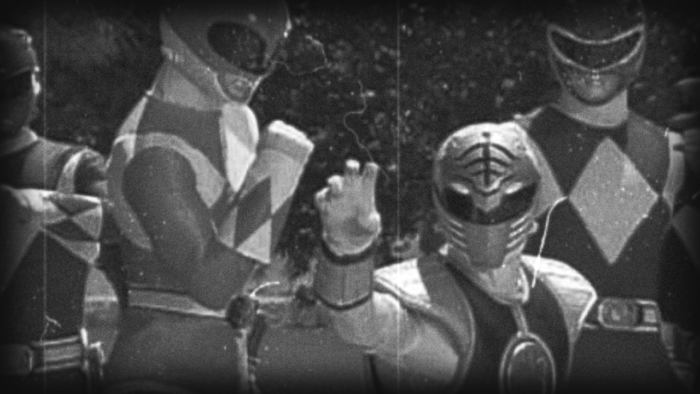
Power Rangers Without the Import Footage
While Mystic Knights shared visual DNA with Power Rangers, its production told a very different story. Unlike most live-action action shows of the era, it did not rely on repurposed Japanese footage. Instead, it was filmed primarily in Ireland and Germany, using real landscapes and historic locations.
The cast was largely Irish, grounding the fantasy in authentic accents and performances that matched the setting. This gave the series a texture that felt closer to Hercules: The Legendary Journeys or Xena: Warrior Princess than to brightly colored superhero teams.
Yet, despite its originality, the show could not fully escape the realities of its market.
The Weight of Toys and Expectations
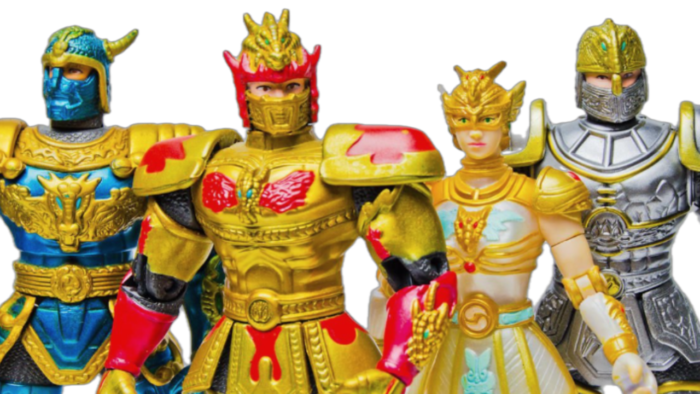
Like nearly all action-oriented children’s programming of the 1990s, Mystic Knights of Tir Na Nog existed alongside a merchandise line. Action figures, weapons, dragons, and playsets were produced to accompany the series.
This relationship shaped creative decisions behind the scenes. Some requests from toy partners were resisted, while others were unavoidable. Certain elements introduced for merchandising purposes clashed with the show’s mythic tone, creating moments that felt out of place within its carefully built world.
The tension between storytelling and toy sales was not unique to Mystic Knights, but it proved especially difficult for a series trying to establish a distinct identity.
A Second Season That Never Came
Plans were made for a continuation titled Mystic Knights: Battle Thunder. Logos were designed. Story elements were considered. A second wave of toys was drafted.
But the momentum never materialized.
Toy sales failed to meet expectations set by Power Rangers, an almost impossible benchmark. Production costs remained high, and Saban Entertainment shifted its focus toward properties with stronger returns, including later seasons of Power Rangers and the English adaptation of Digimon.
By the end of its first season, Mystic Knights of Tir Na Nog quietly came to an end.
A Legacy Defined by What It Tried to Be
Today, Mystic Knights of Tir Na Nog is difficult to find. It is not widely available on streaming platforms, and only a limited number of home releases exist. For many viewers, it survives primarily through memory, scattered recordings, and online uploads.
At first glance, it may appear to be another attempt to capitalize on a trend. But beneath the surface, it represents something more sincere.
It was an effort to tell a fantasy story rooted in mythology rather than formula. It was a Western response to a genre dominated by imported structures. It was a series that tried to grow its characters, expand its world, and take its premise seriously — even when the market demanded otherwise.