As far as we know, only two members of the original Gotei 13 still held captain positions centuries later. One of them is Retsu Unohana. At first glance, Unohana seems simple. Calm. Gentle. Almost invisible compared to louder captains. She rarely fights. She heals instead of kills. But the Thousand-Year Blood War arc forces us to reevaluate everything we thought we knew about her.
Because Unohana was never just the kind-hearted captain of Squad 4.
She was also Yachiru Unohana — the first Kenpachi, the most dangerous criminal Soul Society ever produced.
Understanding Unohana means understanding how these two identities coexist, and how Tite Kubo quietly foreshadowed her true nature for hundreds of chapters.
Unohana’s Deceptive First Impression
Unohana first appears in Chapter 81 and Episode 24 of the anime. Her youthful face, soft voice, and polite manner make her seem like one of the younger captains. In reality, she is one of the oldest Shinigami alive and a founding member of the original Gotei 13. Even respected captains like Shunsui Kyōraku and Jūshirō Ukitake refer to her as “senpai,” signaling her seniority.
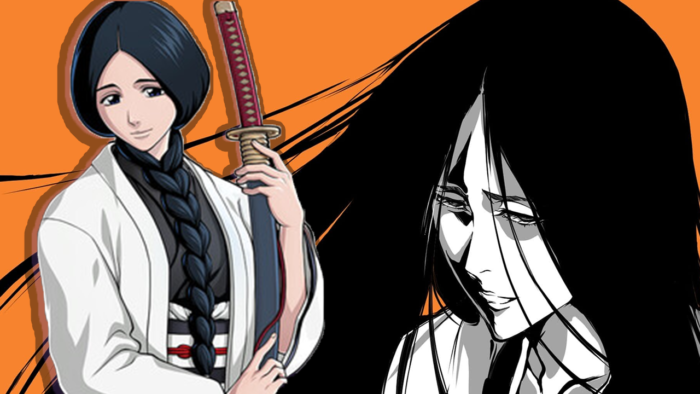
Her design reinforces this misdirection. Long black hair braided over her chest, gentle blue eyes, and a constant calm smile. That braid, however, hides a scar on her collarbone — a detail that would not be explained until much later. That scar is not cosmetic. It is a reminder of the only battle that ever truly satisfied her.
The battle that changed both her life and Kenpachi Zaraki’s.
The Healer of Soul Society
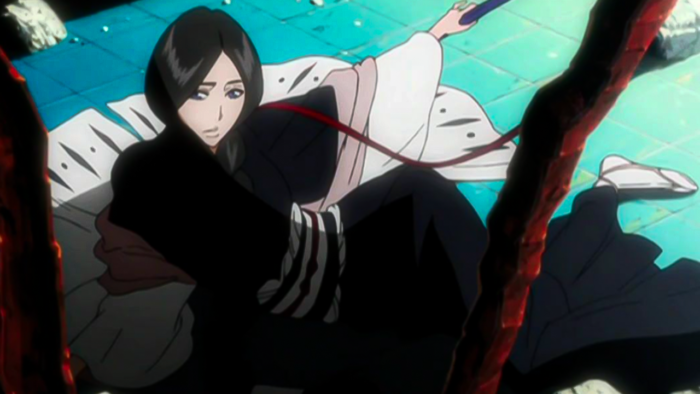
For most of Bleach, Unohana exists as the embodiment of compassion. As the captain of Squad 4, she heals without discrimination. Allies, enemies, humans, Arrancar, Visored — it does not matter. If someone is wounded, she treats them.
This is seen repeatedly throughout the series. She heals Ichigo and his friends after they invade Soul Society. She tends to injured captains after Aizen’s betrayal. She assists in Hueco Mundo and Fake Karakura Town with the same calm focus. Her leadership style is strict but fair, and she values duty above emotion.
When her lieutenant Hanatarō aids the intruders, Unohana reprimands him firmly, not out of anger, but because responsibility matters. Even in discipline, she remains composed.
At this stage of the story, it is almost impossible to imagine her as a master swordsman. Kubo wants the audience to believe this version of Unohana is the whole truth.
Yachiru Unohana: The First Kenpachi
The Thousand-Year Blood War arc reveals Unohana’s past in devastating detail. Before she became a healer, she was one of the most feared criminals in Soul Society history. She mastered countless sword styles and named herself “Yachiru,” meaning “Eight Thousand Styles.”
Head Captain Yamamoto personally selected her as a captain in the original Gotei 13. She led Squad 11, the division dedicated entirely to combat. The ruthless values that define the 11th Division today were founded by Unohana herself.
She was the first Shinigami ever given the title of Kenpachi — the strongest.
Her interest in healing was never about mercy. She learned medical techniques so she could heal herself mid-battle and continue fighting longer. Even her compassion has roots in violence.
The Battle That Changed Everything
Unohana’s life changed the day she encountered a nameless boy standing atop a pile of corpses in Rukongai.
That boy was Kenpachi Zaraki.
For years, Unohana searched for someone who could challenge her. She slaughtered opponent after opponent, growing increasingly bored. Then Zaraki attacked her — and wounded her. The cut to her collarbone thrilled her. For the first time in centuries, she felt joy.
Zaraki felt it too.
But that joy came with fear. Zaraki realized that if he killed Unohana, he would lose the only opponent who ever satisfied him. Subconsciously, he suppressed his own power to prolong that feeling.
Unohana won the battle, but she understood the truth. Zaraki was stronger. Her weakness caused him to restrain himself, and she viewed that as her sin.
From that moment forward, Unohana abandoned the path of the sword. She relinquished her title, her division, and her identity as Kenpachi. The healer Retsu Unohana was born from that choice.
Foreshadowing the Monster Beneath the Calm
Looking back, Kubo left subtle hints everywhere.
Unohana doubts Aizen’s death before anyone else. She understands Kyōka Suigetsu’s danger immediately. She insists Ichigo never witness Aizen’s Shikai. She calmly intimidates Ichigo when his spiritual pressure falters, revealing a chilling authority beneath her kindness.
Even her eyes change. In certain moments, the warmth disappears, replaced by something cold and ancient. The same stare she would later turn on Zaraki in Muken.
These moments mean nothing on a first read. After the final arc, they become impossible to ignore.
The Muken Duel and Unohana’s Purpose
When Soul Society needs Kenpachi to awaken his true strength, Unohana is chosen to train him. Not as a teacher — but as a sacrifice.
In the depths of Muken, Unohana reveals herself fully. Calm, ruthless, precise. She kills Zaraki over and over, healing him each time, forcing him past his fear. Each death strips away another self-imposed limiter.
When she finally releases her Bankai, Minazuki, the battlefield becomes drenched in blood — a visual expression of her true nature. This is not a healer fighting. This is the original Kenpachi reclaiming her role one final time.
Unohana knows how this ends. The strongest Shinigami cannot protect themselves once they find a successor. Their blade must either kill that successor or nurture them.
Unohana chose to nurture.
When Zaraki finally surpasses her, Unohana accepts death without regret. She congratulates him. She passes on the title she could not properly give him centuries ago. Her life’s purpose is fulfilled.
Retsu Unohana only existed to create Kenpachi Zaraki.
Her death is not tragic. It is complete.