
Most isekai anime are built on excess. Bigger worlds, louder powers, faster escalation. Heroes who gain godlike abilities before they’ve even figured out where they are. It’s a genre obsessed with momentum — always moving forward, always demanding more attention.
Campfire Cooking in Another World with My Absurd Skill does something quietly radical by comparison: it slows down.
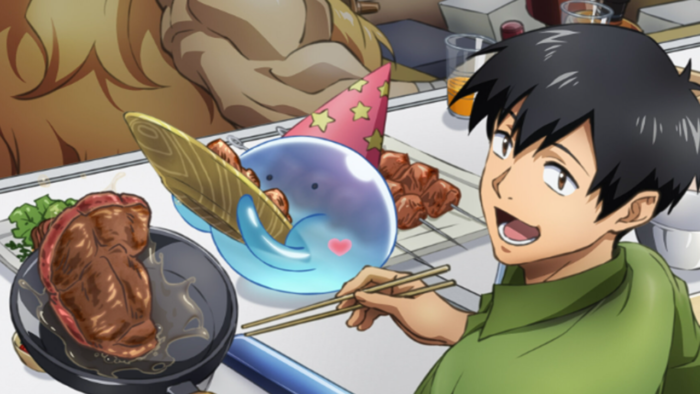
The anime doesn’t open with destiny or prophecy. Its protagonist, Mukoda Tsuyoshi, isn’t chosen for greatness — he’s summoned by mistake. His special ability isn’t combat or magic, but access to a modern grocery store. And instead of turning that into a gag or a shortcut to power, the series treats it as something far more interesting: a way to survive comfortably in an unfamiliar world.
That choice defines everything that follows.
Mukoda doesn’t want to conquer anything. He doesn’t want recognition or influence. He wants safety, stability, and good food. In a genre where ambition is usually framed as heroism, Campfire Cooking in Another World reframes contentment as the real goal. Fans often latch onto this immediately, describing the show as refreshing not because it subverts isekai tropes loudly, but because it simply refuses to participate in them.
Food becomes the emotional language of the series. Meals aren’t interruptions between plot beats; they are the beats. The anime lingers on preparation, texture, and shared reactions. These scenes feel intentionally indulgent, almost meditative. Viewers frequently describe the show as something they watch when they’re tired — not bored, but worn down. It’s an anime that doesn’t ask you to keep up. It meets you where you are.
Even when power enters the story, it never overwhelms the tone. Mukoda travels with beings who could flatten armies — a legendary Fenrir named Fel and a slime named Sui that steadily evolves into something frighteningly strong. But their strength exists to preserve peace, not disrupt it. The show resists the genre’s usual instinct to escalate. There’s no arms race, no constant need to prove who’s stronger. The power fantasy is present, but it’s deliberately muted.
This restraint is why fans so often describe the series as a “comfort isekai.” There’s no looming catastrophe forcing urgency. Episodes feel complete in themselves, like stops along a long journey rather than chapters in a race. Some viewers compare it to a road trip anime, where the joy comes from the experience rather than the destination — a comparison that feels especially apt in a genre usually obsessed with end goals.
Ironically, this is also why Campfire Cooking in Another World was easy to overlook. It aired alongside louder, flashier shows with clearer hooks. Its premise sounded small. Domestic, even. Many fans admit they skipped it initially, only to return later and realize it was offering something they hadn’t known they needed.
What the anime ultimately provides is a different kind of escapism. Not the fantasy of power, but the fantasy of rest. A warm meal after a long day. A safe place to sleep. Companionship without pressure. Another quiet tomorrow.
In a genre built around “more,” Campfire Cooking in Another World chooses “enough.” And that choice feels increasingly meaningful in a moment when audiences seem more interested in comfort than conquest.
It isn’t trying to redefine isekai. It’s just gently reminding us that sometimes the most compelling fantasy isn’t being unstoppable — it’s being okay.